Kilimanjaro logistics and data

In the spring of 2025, while my brother and I were doing the W-trek in Torres del Paine. The weather was blustery, forcing us to shelter in the lodges and really get to know the fellow trekkers. One of them is a Goldman Sachs VP in his late forties or fifties, and mentioned that he did Kilimanjaro which immediately piqued my interest. The ego in me said “If he can do it so can I.” Unhealthy, but such is life.

I did summit Kilimanjaro this past October, placing it at the top (no pun intended) of my physical achievements… so far. I just want to document here the more logistical and technical aspects which I hope will help others in planning or deciding on this trip. For my sanity’s sake, I’ll be using bullets instead of paragraphs:

    • I went with Gladys Adventures, and I can happily recommend the company. From conversations, I was told that opting for the cheapest company results in the porters getting shortchanged and food quality suffering. On the other hand, I’m not sure what more expensive treks get you. I also did the open group which was great.  Make sure the tour has private toilets!
    • I did the 8 day Lemosho route, which was highly recommended from my research. Some of my experiences might be specifically for this route.
    • A base level of fitness is needed, but it honestly doesn’t seem that high. The total number of mileage per day was actually small, with the exception of summit day where the descent was very rough. Just go out hiking on weekends with some amounts of weight for three months. That being said, the crux was the altitude. Being in better shape can help, but it is high variance in terms of human response. Be prepared to feel shitty, but the altitude effects usually pass. The guides generally care a lot about your health, but they do push you if the illness is not “serious.” e.g. there are no “zero days” if you’re on these hikes, and must push through. This is hard to train, and relies on pure grit.
    • I packed based on the gear list provided by Gladys. It was sufficient, but I want to highlight what I thought were winners and losers:
      • Down jackets – I brought a Rab neutrino pro just for this trip and boy was I glad. Loved the warmth. My lighter down was useful for layering too.
      • Gaiters – Optional but highly useful for maintaining sanity.
      • Nalgene – I liked my Nalgene, but did wish I also brought a bladder.
      • Grayl – Not needed; really was unwieldy.
      • Buff – I wish I brought a real buff, instead of just scarfs. It was extremely windy.
      • Wet wipes – while we were provided “washy washy” aka warm water in a pan, having wet wipes helped more in terms of keeping myself clean.
      • Trail runners – My Hokas did great; did get very dusty but so did everything else.
      • Glove liners – I wish I brought actual liners instead of just thin gloves.
      • Pack + trekking poles – knowing how to properly weigh and use poles and my pack made everything smoother.
      • Diamox – I took a half dose (split a 125mg pill) because I didn’t like the side-effects. Maybe it worked, maybe it didn’t?
      • Camera – a lighter, weather-sealed camera would’ve been better. My lens and body combo was just a bit too heavy.
      • Sun protection – I used a lot of physical sun protection, and was fine for the whole trip.
    • Food-wise, we were fed a bunch of carbs. Each meal started with soup, and then a combination of rice or pasta with curry-like veggies and proteins, ending with some fruit. Eating was a struggle, and I think packing high fat/protein would’ve been useful. A lot of the soup relies on milk powder, meaning those who are lactose-intolerant should prep.
    • Hygiene was possible to maintain, compared to a standard backpacking trip. As said above, the guides provided fresh water after the days hike. I was able to wash my face and feet quite easily, and use the wet wipes to maintain more intimate areas.
      The private toilets were life changers.
    • Trust the guides on acclimation – below I post my Garmin data. Note that on the summit push, my heart rate was lower than some earlier days. We did go a lot slower, but somehow, the acclimation worked and I was very prepared for the top.
    • I arrived two nights before “Day 0”, and I liked that. This allowed me to have time change, and allow for my delayed bag to arrive. Others did a safari beforehand which also seemed nice.
    • The worst parts of the trip was definitely the 9k feet descent on summit day; we also had to deal with tipping, which took much longer than it should.
    • Should you do it? If you’re at all considering it, then yes.

I tracked a majority of the trek on my Garmin, and aggregated my own data. See below for a small summary, with a link to a more complete picture.

Open the full dashboard (per-day and stage-by-stage detail)

Get Out

A strangely hilarious movie draped with horror tropes and a large amount of allegories of racial relations in America. It portrays African-Americans as objects with traits that white (and the token Asian) Americans desire for themselves. Certainly the stereotype of speed, muscles and, uhm, other physical properties is just so pronounced.

There’s just a few questions I don’t understand. Why go through all that trouble for Rose to operate a honeypot? Wouldn’t someone in this day and age notice Rose’s Facebook page? Wouldn’t the first impression that Rose is used to the groundskeeper and housekeeper be an incredible tip-off? Why would the grandparents keep on doing manual labor after transferring their minds? Why black people to transfer to?

Still, super fun movie.

Referencing Copies

A lot of times in numerical methods, I need to have a temporary variable as a time stepping tool or as an “incrementing” device without altering the original variable. A code snippet like

copy_u = u
for i in range(len(copy_u)):
    copy_u[i] = f(u)

But I gotta be more careful. There’s a deep difference between making a copy of a variable, and just creating a reference to a variable. Any change to copy_u might change u itself! Use np.copy or the copy module in Python!

Emerson

“Let me never fall into the vulgar mistake of dreaming that I am persecuted whenever I am contradicted.”


Last Semester

Today marks the last first day of my undergraduate career, assuming nothing messes up. It was also a productive day, with me unpacking after arriving in Ithaca last night, and finally applied for a CS minor. With this newfound busyness, my mind can’t really stray to be too nostalgic.

When I arrived in my room last night, a wave of nostalgia swept over me. The want for the status quo is quite strong; change seems to be bad now. The best way I can explain it is in terms of mathematics:

For the past 22 years, fortune has smiled upon me. Time after time, the dice has favored my family’s endeavors and health. I fear that the math dictates that tragedy will strike soon with the new dice roll. It seems that my grandma’s health has already started to decline. I was too young to comprehend the death of my dad’s mother, but being 22 means I will understand now.

Am I scared of this? Oh definitely. Is this fear irrational? I think so.

The Question of Why

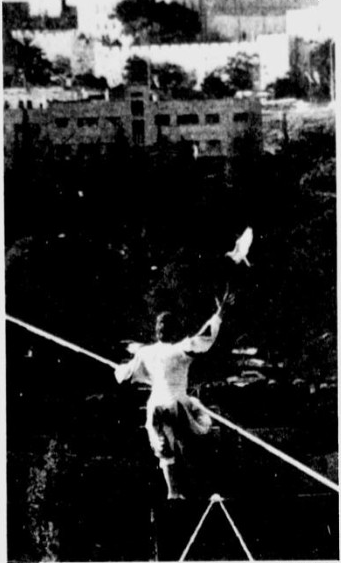
Philippe Petit Walks Over Jerusalem

NPR’s TED Radio Hour latest podcast was titled “To The Edge” where adventurers discussed, amongst other topics, why they did what they did. One wanted to escape the mundane life of a management consultant. Philippe Petit wanted it for the beauty. The most famous answer is the quintessential “because it is there.”

There are actually thousands of adventurers among us who make that aphorism their motto. They eat, drink, sleep at places we think cannot be the mark of a swashbuckler though, and scale great obstacles we cannot see. Those people are the researchers who teeter at the edge of human knowledge.

To do research is to literally step off the edge of what humanity knows, and try to expand that swath just a tiny bit so that someone can stand on where there use to be nothing. For most of them in science, they might see their work used by a doctor at some point, or become an intricate cog in the unifying proof of everything. Their goals might be similar to my own, in bettering the world to a visible extent.

On the other hand, those who toil in philosophy, history or language, I never can fully understand why do they do it? Maybe they do it simply for the beauty (though as a mathematician, I’m biased that mathematics is the most beautiful). The best reason reason that I have construed is simply “because it is there”; that knowledge for the sake of knowledge is innately useful.

And I find that beautiful too.

Notes: SSD edition

Some notes from the past week:

  1. It is incredibly easy to be an impostor in a more academic party. First of all, most of the people will be already intoxicated to the point where bullshit science can’t be discerned from actual science. This is good as I can just say random facts I remember from Popular Science.Another acceptable thing to do is to just ask questions upon questions. “What’s your research? … Oh that’s so cool! Tell me more about it! … So does this connect to insert scientific news here? Wow.” That’ll burn around 5 minutes minimum.The main problem comes when you run out of questions in the initial barrage. It also fails when the person is laconic or can’t speak English.

  2. Installing a SSD is extremely easy, but installing operating systems are hard. Right now, I have around 8 entries on my GRUB menu before I migrate everything over to my new distro.I followed the mount guide provided here, which seems intuitive enough on where to put mount points. I’ve also learned that
    mount

    and

    df -h

    are my friends. There’s also that good GParted software.

  3. The Lloyd Trefethren numerical linear algebra book is quite good for a quick overview of the subject. It doesn’t get bogged down with the analysis, and generally refers to other books (mainly the Van Loan) throughout.
  4. Holy shit URF mode.
  5. I need to be more brave in a certain subject….

Damn

Didn’t even make top 500 for Putnam this past year. What a disappointment for me…

Flowers for Algernon

Any one who has common sense will remember that the bewilderments of the eyes are of two kinds, and arise from two causes, either from coming out of the light or from going into the light, which is true of the mind’s eye, quite as much as of the bodily eye; and he who remembers this when he sees any one whose vision is perplexed and weak, will not be too ready to laugh; he will first ask whether that soul of man has come out of the brighter light, and is unable to see because unaccustomed to the dark, or having turned from darkness to the day is dazzled by excess of light. And he will count the one happy in his condition and state of being, and he will pity the other; or, if he have a mind to laugh at the soul which comes from below into the light, there will be more reason in this than in the laugh which greets him who returns from above out of the light into the cave.

I read the short story on my way to Boston, and it was incredibly thought-provoking. If such an operation is real, would I choose to take part in it? To be able to glimpse into a far brighter world, and then submerge back into the clouded abyss that limits my mind seems…

Man, I honestly don’t know how to put my feelings about such a thing to words.

I assume that I will remember I had the operation, and remember my brilliance during those few weeks which I could understand everything. My life after I returned to the normal state would be unpleasant to say the least. “I used to know this! I used to understand this! Why can’t I do this anymore!”

But how I wish to glimpse into the mind of a genius; to see a larger picture, even for just a few minutes.

Garlic

  • Using fresh garlic is amazing, especially compared to those minced-garlic-in-a-bottle. It doesn’t instantly become brown and cooked after you put it in hot oil. Same thing holds for ginger versus the ground ginger you find in the spice aisle.
  • I’ve somehow found the art of frying chicken with minimal oil. It tasted decent, but it was still literally fried.
  • Basting oil is amazing. Adds so much aroma to roasting brussel sprouts.